




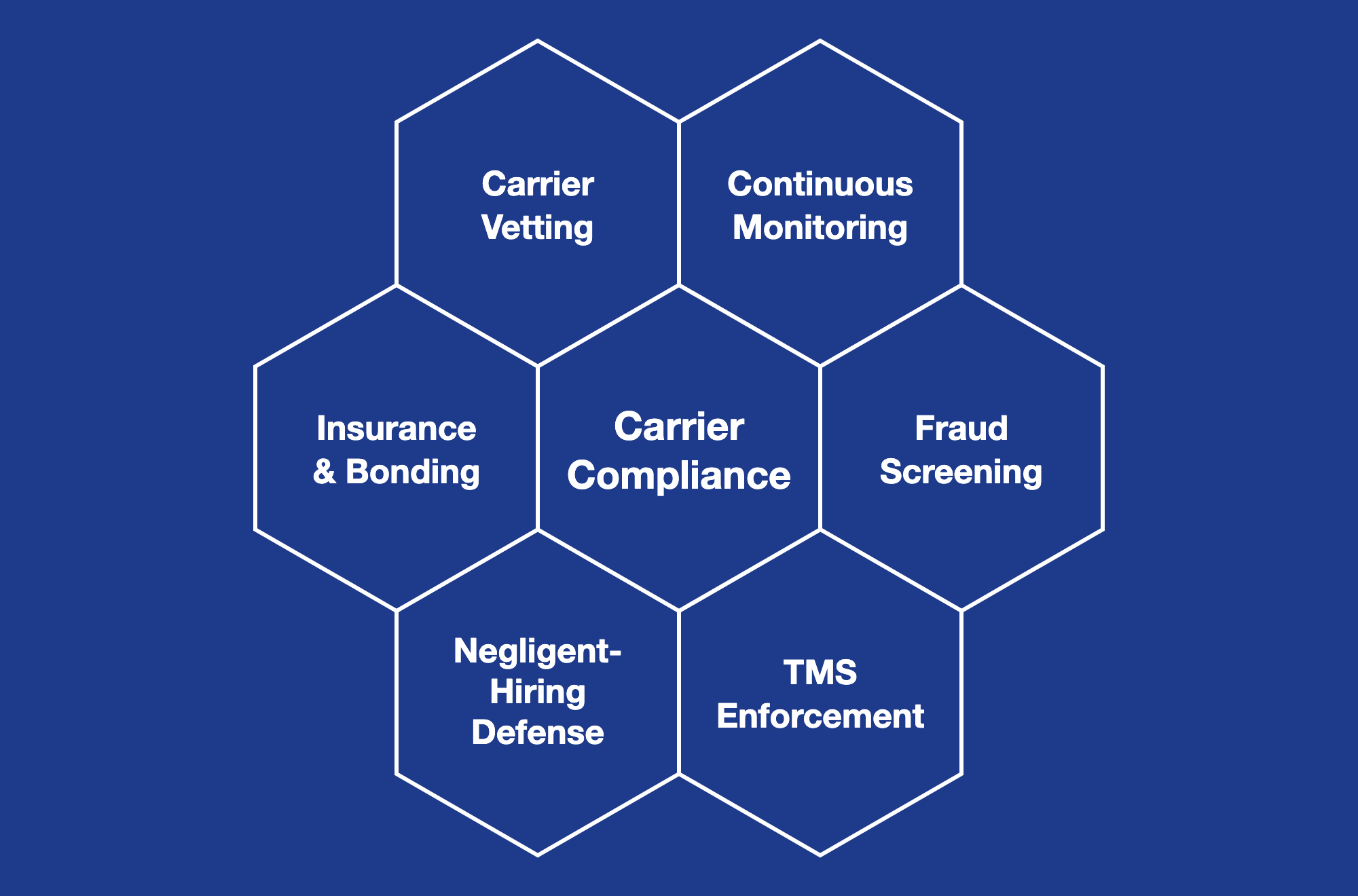
An independent audit of your carrier vetting and compliance program designed to meet post-Montgomery negligent-hiring standards, 2026 FMCSA rules, and insurer underwriting requirements.
Why a Carrier Vetting and Compliance Audit Now
The carrier-compliance landscape changed materially in 2026. Three converging shifts make a defensible, third-party-audited carrier-compliance program essential — not just for risk mitigation, but for insurance underwriting, board governance, and competitive positioning.
- Montgomery v. Caribe Transport II (U.S. Supreme Court, May 14, 2026) — The Court ruled unanimously that state-law negligent-hiring claims against freight brokers are not preempted by the Federal Aviation Administration Authorization Act. Brokers can now be sued in state courts for unreasonable carrier selection.
- FMCSA Broker Financial Responsibility Rule (effective January 16, 2026) — A freight broker’s operating authority can be suspended if financial security falls below $75,000 and is not cured within seven days. Up to 90% of BMC-85 trustees no longer qualify under the new strict asset requirements, forcing migration to BMC-84 surety bonds for many brokers.
- Insurance underwriting — Contingent-auto and cargo premiums are projected to rise 3–5x in 2026. Insurers now require third-party evidence of advanced vetting, continuous monitoring, and SOP (Standard Operating Procedure) discipline before they will issue or renew coverage at any price.
A&A’s Freight Broker Carrier Vetting and Compliance Audit produces a defensible, evidence-based assessment of a freight broker’s program against the 2026 standard of care, along with a remediation roadmap.
What the Audit Covers
The audit is structured around eight sections covering the full carrier-compliance program:
- Carrier Vetting Standards — FMCSA SAFER use, digital identity proofing (NIST 800-63A alignment), IP geofencing, domain/email verification, banking verification, SCAC-identity tie-out (NMFTA Persona, February 2026 standard).
- Continuous Carrier Monitoring — Move from point-in-time to continuous monitoring; auto-deactivation of carriers when authority, insurance, or safety status changes; API integrations with compliance application vendors such as RMIS, Highway, and Carrier Assure.
- Pre-Tender Fraud Screening — Load-level predictive scoring (Highway Lane Certainty, Carrier Assure scoring, GenLogs chameleon-carrier detection); identity verification at the tender stage.
- TMS Enforcement Architecture — “Friction by design”: hard-block load tender prevention in the TMS; override-authority controls; documented executive-level approval pathway for any compliance bypass.
- Operational SOPs and Training — Pressure-resistant SOPs (resist carrier social-engineering); separation of carrier vetting from commissioned sales; escalation matrices; anti-phishing training cadence.
- Insurance and Bonding Readiness — BMC-84 vs BMC-85 status post-January 2026 rule; surety qualification; contingent-auto and cargo coverage adequacy; insurer-required compliance evidence.
- Negligent-Hiring Defensibility — Documentation supporting carrier-selection decisions; reasonable-care evidence under Montgomery v. Caribe Transport II; records-retention policy.
- Regulatory Compliance — FMCSA Broker Financial Responsibility Rule ($75K threshold; 7-day cure); Broker Transparency Rule readiness (49 CFR Part 371); FMCSA Motus registration migration.
Audit Methodology
Our methodology is structured around six phases over a 6–8-week engagement. Every finding is evidence-based and traceable to source documentation:
- Phase 1 — Kickoff and Scoping (Week 1): Stakeholder interviews (CEO, COO, General Counsel, CFO/compliance lead). Confirm engagement scope, in-scope entities, sample-size targets, document requests, and NDA execution.
- Phase 2 — Document and Data Review (Weeks 1–3): SOP review, compliance system vendor contract review, TMS configuration walkthrough, 90-day audit log pull, 12-month fraud-incident review, training records, and insurance documents.
- Phase 3 — Carrier-File Sample Audit (Weeks 3–5): Random sample of 30 carrier onboardings (stratified by risk) audited against SOP and 2026 best-practice baseline. Identity-verification spot-checks. High-risk-load handling review.
- Phase 4 — Staff Interviews and Process Observation (Weeks 4–6): Three to five confidential interviews with account management, carrier sales, and compliance staff. Two test-call scenarios (with consent) to evaluate SOP resistance to social-engineering pressure.
- Phase 5 — Report Drafting and Review (Weeks 6–7): Draft report with gap analysis, defensibility scorecard (Level 1–4 rating per section), prioritized remediation roadmap, sample SOP language, compliance systems vendor stack recommendation.
- Phase 6 — Delivery and Walk-Through (Weeks 7–8): Final report delivery, 90-minute executive walk-through, 30-day follow-up call to address remediation questions.
Defensibility Scorecard
Every section of the audit receives a rating from Level 1 to Level 4 against the 2026 standard of care. The scorecard is designed to be defensible in three settings: (1) an insurer’s underwriting committee, (2) a board or audit-committee meeting, and (3) a courtroom in a carrier negligent-hiring matter.
Deliverables
- Written audit report — Typically 25 to 35 PowerPoint pages, organized by the eight audit sections. Each section includes (i) what was evaluated, (ii) evidence gathered, (iii) Level 1–4 rating, (iv) specific findings with risk classification, and (v) prioritized remediation recommendations.
- Defensibility scorecard — Single-page summary of Level 1–4 ratings across all eight sections, suitable for board, insurer, or executive distribution. Includes a single composite rating and a three-year trend if engagement is recurring.
- Prioritized remediation roadmap — Action items with owner and dependencies.
- Sample SOP language — Drafted in A&A’s standard format for any SOP sections identified as missing or deficient. Ready for client legal review and adoption.
- Vendor stack recommendation — Independent, non-referral-fee assessment of which compliance vendors (RMIS, Highway, Carrier Assure, GenLogs, Transflo, others) best fit the freight broker’s size, lane profile, and risk posture.
- Executive walk-through — 90-minute final presentation to the client’s executive team.
- 30-day follow-up — Single call to address remediation questions and ensure recommendations are being operationalized.
Why A&A
- 46 years of experience: A&A has been the leading independent research, consulting, and M&A advisory firm in the 3PL market since 1980. Our research is cited in industry publications, securities filings, and academic work; our newsletter reaches over 88,000 subscribers worldwide.
- Expert-witness depth in broker-specific matters. CEO Evan Armstrong has been an industry expert in freight brokerage lawsuits, including cases involving accident liability, cargo loss, fraud, and theft. Evan’s career includes cargo claims responsibility as a VP at Roadrunner Freight Systems. The defensibility framework underlying this audit is built directly from that case experience and is designed to withstand cross-examination.
- Operational experience with carrier vetting. Carrier vetting, onboarding, and ongoing carrier management are recurring components of A&A’s strategic planning engagements with freight brokers. The methodology in this audit reflects what has worked and what has failed in freight broker operations.
- Vendor-independent. A&A does not receive referral fees from any carrier vetting and compliance vendor and is not affiliated with any insurer, broker association, or carrier rating service. Our recommendations are made on the merits.
Engagement Terms
Pricing. Custom proposal based on time and materials, scoped to broker size and complexity. Engagements are sized after an initial scoping call.
Consulting Agreement. The standard A&A consulting agreement is sent within 24 hours of mutual interest. The engagement can begin within two weeks of execution of the consulting agreement.
Independence. A&A maintains independence from carrier-compliance vendors, insurance carriers, and the engaged broker. Findings are made on the merits and reported without modification.
Contact
To request a scoping call for an A&A Freight Broker Carrier Vetting and Compliance Audit:
Evan Armstrong, CEO
Armstrong & Associates, Inc.
13400 Bishops Lane, Suite 70, Brookfield, WI 53005
Mobile: +1-414-305-3138
Email: Evan@3PLogistics.com
This service brief is for informational purposes and does not constitute legal advice. A&A is not a law firm and does not provide legal opinions. Clients should engage qualified counsel for legal interpretation of FMCSA rules, the Montgomery decision, or any other authority referenced herein.